Followers

Monday, February 28, 2022

DR CHANDRA ON UKRAINE ...


UNDERSTANDING THE CONCERN OF THE OTHER.
Chandra Muzaffar
The mainstream Western media is almost unanimous in demanding
that Russia and Vladimir Putin stop their military operation in Ukraine immediately. This in their opinion is the only solution to the current conflict. However, if one attempts to understand how the current conflict had evolved, one would ask not Russia but the US led Western alliance to bring down the political temperature as a first step.
The roots of the present conflict have to be traced back to the end of the Cold War in 1991. The leader of the Union of Soviet Socialist
Republics (USSR), Russia’s predecessor, Mikhail Gorbachev felt that if peace is to greet the demise of the Cold War then the military
posturing that signified that era should be buried once and for all.
For his part, Gorbachev was prepared to dismantle the Warsaw Pact that the USSR helmed which was his country’s response to the US led North Atlantic Treaty Organisation (NATO). All that he asked for in return was a firm commitment that NATO would not expand eastwards, extend its military power to the states adjacent to Russia thus posing a security threat to the latter.

Though the undertaking
that Gorbachev sought was not engraved in written language,
American leaders at that time like President Ronald Reagan and
Secretary of State James Baker had some notion of the gravity of the verbal pledge they had given to their Russian counterpart.

It is a pity that in the years that followed, the US government made
no attempt to give substantive meaning to that pledge. On the
contrary, in 1997, three former Warsaw Pact states, Hungary, the
Czech Republic and Poland, were invited to hold talks on joining
NATO. On 27th March 2020, all 3 joined NATO, in spite of protests
from elements in the Russian leadership. A few other states that
were once part of the USSR and others allied to Russia in the past
have now joined NATO.
It is against this background that one should view events in 2014 that exacerbated Russia –Ukraine ties in relation to NATO. These events are directly linked to the current conflict in Ukraine. The
democratically elected president of Ukraine, Victor Yanukovich, who
was not prepared to follow blindly the dictates of Western powers
was unceremoniously removed from power through the
manipulation of parliamentary procedures and replaced by a new
regime more inclined towards Washington.
Though the Yanukovich government was seriously flawed in some ways, his engineered ouster which strengthened the hands of neo-Nazi and fascist elements, spawned virulent anti-Russian rhetoric and spiked street violence has left deep scars upon Ukranian society. The separatist tensions and turmoil in parts of Eastern Ukraine in the last eight years that have taken the lives of at least 14,000 people can only be understood within the context of this post-2014 scenario.
It is also this scenario that explains in part why Russian president Vladimir Putin acted the way he did in Crimea in Eastern Ukraine. The overwhelming desire among the vast majority of the people of
Crimea to re-link their land to Russia affirmed in the 2014
Referendum is irrefutable proof of how ordinary citizens view their
security and well-being.
This is why loose talk in Kiev and Washington in the last few months that ‘Ukraine should join NATO’ or that ‘ Ukraine should acquire nuclear weapons’ in the end produced a backlash effect. It increased anxiety among both elites and citizens in Russia about security concerns. It is important to emphasise yet again that this concern for their collective security as a nation and as a people is what Vladimir Putin, Sergei Lavrov and other Russian leaders have tried to convey to their counterparts in Washington, London, Paris, Berlin and indeed every other Western capital for more than 20 years since the end of the Cold War.
Simply put, Russia does not want a Western military
alliance--- NATO --- perched at its gate. The West has refused to
address this very legitimate concern. Worse, it has wilfully chosen to
brush aside Russia’s fear. Bluntly put, Moscow has now been provoked to act. Since Washington in particular was not willing to use diplomacy to address Russia’s fear, its concern, Moscow has opted for a special ‘military operation’. Moscow’s response is perfectly understandable. It is completely rational.
Perhaps we should all remind Washington and the West of a
fragment of their own history to help them appreciate better what is happening now in Ukraine. In 1962, there was a huge international political crisis. We thought we were on the verge of a world war. The USSR had deployed missiles in Cuba, on the soil of its ally, facing their common foe, the United States. Cuba was just 90 kilometres from the US shoreline. The US president, John Kennedy, saw it as an act of provocation. He wanted the missiles removed immediately.
Otherwise, he would attack Cuba. After some negotiations, Cuban
leader Fidel Castro requested his Soviet friends to remove the
missiles. The Cuban crisis was defused. In response to Castro’s decision, Kennedy, it is alleged, undertook not to overthrow Castro through illegal means. Whether he kept his word or not, it was not really tested because Kennedy was assassinated in November 1963 before he could complete his second term as US president. Some of his successors tried to undermine Castro but that is another story.
Cuba 60 years ago is relevant to the present situation in Ukraine.
Just as the US did not want Russian missiles at its doorstep in 1962,
Russia in 2022 does not want overwhelming Western military power
at its gate today. The Cuban leadership understood what had to be
done to assuage American fears. One hopes that the US and Western governments today realise why it is so important to allay a legitimate Russian concern about its security.
In a nutshell both situations demand an appreciation of that ancient truth found in all spiritual and moral traditions: do not do to others what you do not want others to do to you. It is a truth that has been described as the fundamental ethic in relations between human beings, communities and states. It is, in plain language, the Golden Rule of Life. The US elite in particular has shown so little regard for this golden rule in international affairs.
Dr Chandra Muzaffar is the president of the International Movementfor a Just World (JUST).
MALAYSIA.
25 February 2022.

Monday, January 31, 2022

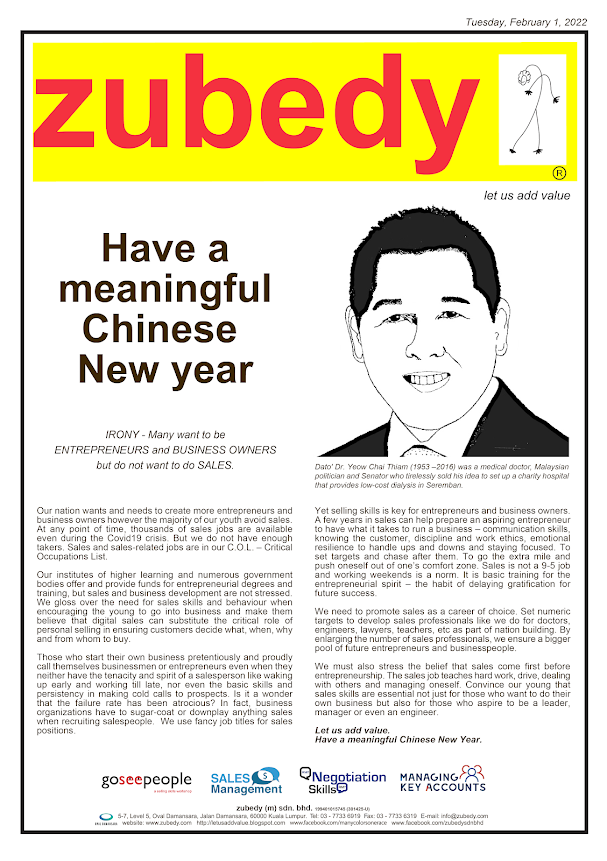
Have a meaningful Chinese New Year - 2022

IRONY - Many want to be ENTREPRENEURS and BUSINESS OWNERS but do not want to do SALES.

Our nation wants and needs to create more entrepreneurs and business owners however the majority of our youth avoid sales. At any point of time, thousands of sales jobs are available even during the Covid19 crisis. But we do not have enough takers. Sales and sales-related jobs are in our C.O.L. – Critical Occupations List.

Our institutes of higher learning and numerous government bodies offer and provide funds for entrepreneurial degrees and training, but sales and business development are not stressed. We gloss over the need for sales skills and behaviour when encouraging the young to go into business and make them believe that digital sales can substitute the critical role of personal selling in ensuring customers decide what, when, why and from whom to buy.

Those who start their own business pretentiously and proudly call themselves businessmen or entrepreneurs even when they neither have the tenacity and spirit of a salesperson like waking up early and working till late, nor even the basic skills and persistency in making cold calls to prospects. Is it a wonder that the failure rate has been atrocious? In fact, business organizations have to sugar-coat or downplay anything sales when recruiting salespeople.  We use fancy job titles for sales positions.

Yet selling skills is key for entrepreneurs and business owners. A few years in sales can help prepare an aspiring entrepreneur to have what it takes to run a business – communication skills, knowing the customer, discipline and work ethics, emotional resilience to handle ups and downs and staying focused. To set targets and chase after them. To go the extra mile and push oneself out of one’s comfort zone. Sales is not a 9-5 job and working weekends is a norm. It is basic training for the entrepreneurial spirit – the habit of delaying gratification for future success.

We need to promote sales as a career of choice. Set numeric targets to develop sales professionals like we do for doctors, engineers, lawyers, teachers, etc as part of nation building. By enlarging the number of sales professionals, we ensure a bigger pool of future entrepreneurs and businesspeople.

We must also stress the belief that sales come first before entrepreneurship. The sales job teaches hard work, drive, dealing with others and managing oneself. Convince our young that sales skills are essential not just for those who want to do their own business but also for those who aspire to be a leader, manager or even an engineer.


Let us add value.

Have a meaningful Chinese New Year.


Friday, December 24, 2021

HAVE A MEANINGFUL CHRISTMAS - REFLECTING: Strengths, Weaknesses and Bad Habits.

 REFLECTING: Strengths, Weaknesses and Bad Habits

Self-Managed Learning demands that we take charge of our future; focus, operate from our strengths and deal with our bad habits.

It is a good time of the year to do some deep reflection and rethinking. Ask for and listen to feedback. Measure success – where we did well and where we failed. With feedback and deep reflection, we know what our real strengths, weaknesses and bad habits are. Reflection is necessary for the individual, an organization, and the nation.

This exercise is crucial as we can only perform from our strengths. We must concentrate on our strengths and place ourselves where we can produce the best results. We must not waste our energy trying to improve on areas of low impact on performance. We cannot build performance on weaknesses.

But it is crucial that we deal with our bad habits. Bad habits are things we do or fail to do that can dilute, negate, or even destroy our strengths. A talented entrepreneur who has the flair to make a lot of money will in the end go bankrupt if he has the bad habit of gambling.

In your organization, what are the bad habits that inhibit performance and excellence? Big plans without follow through? Lengthy meetings with few outcomes? The practice of artificial harmony where most managers avoid difficult conversations? Or simply the general lack of following S.O.P.?

How about we as a nation? What are the bad habits that is eating up our strength? Poor maintenance culture? The practice of corruption? Not being honest on both sides? Cybertrooping at a drop of a hat? Seeing every turn through the lenses of race? 

To be a successful leader, manager or individual contributor, we must learn to recognize our strengths, weaknesses and bad habits and feedback the same to others. To know more, ask us about our Self-Managed Learning Workshop.

Let us add value,

Have a meaningful Christmas


Peace, anas


Tuesday, December 14, 2021

CHOPSTICKS AS A SYMBOLIC REPRESENTATION

"Of Chinese and Malay identities in Malaysia"

Most Malaysian Chinese chose to keep their Chinese ethnic identity and hardly assimilate into the local culture. Mandarin is their first and preferred language.
Many Malaysian Chinese are more ‘western’ in their outlook instead of keeping to their ethnic identity. English is their first and preferred language.
Scores of Malaysian Chinese are more ‘local’ in their outlook – speaks Bahasa Malaysia or the local dialect extremely well especially the Baba Nyonyas and Peranakans.
Most of Malaysian Malays are trying to keep to their Malay identity, still dressing as much as possible as Malays do and enjoy and proud of the Malay language and culture.
Many Malaysian Malays are abandoning their local ethnic identity and becoming more like Saudi Arabs. Arabic is their preferred language, if only they can speak it.
Scores of Malaysian Malays are more ‘western’ in their outlook instead of keeping to their ethnic identity. English is their first and preferred language.
Culture represents a distinctive way of life of a group of people, their complete design for living. It is the complex whole of knowledge, belief, customs, art, skills, morals, traditions, habits, artifacts and objects and common knowledge to the members of the society.
Chopsticks represents part of the cultural symbol of the Chinese community. If we want to take this conversation forward in a positive way, we need to understand it as a symbolic representation of the community instead of harping on chopsticks per se – taking the conversation to the level of coffeeshop banter.
It is obvious that we are not ready to have a mature dialogue on the Malaysian identity. Perhaps we are operating from a society deeply wounded at the emotional level.
Or perhaps, many are simply in self denial 🙂
Peace.
anas zubedy

Wednesday, November 3, 2021

HAVE A MEANINGFUL DEEPAVALI 2021


Why Malaysia needs Leader-Managers who can first and foremost, lead and manage themselves.

"I have a lot of will power, a lot of self-control"
- Jayaram Jayalalithaa
As a young nation, Malaysia needs talents to lead and manage our politics, government, businesses, social organizations, and family units. We need Leader-Managers.
A Leader-Manager is expected to lead and manage four crucial areas.
1. Lead and manage himself or herself,
2. Lead and manage others,
3. Lead and manage the execution of plans and processes, and,
4. Lead and manage change.
While adequate attention and awareness are given to developing talents in items 2 and 4, more work needs to be done for items 1 and 3.
We have many ideas and plans but fall short in executing them well. The shortcomings in leading and managing processes have resulted in countless poor maintenance and slipshod work.
Yet, our biggest challenge is developing talents who can lead and manage themselves; someone with the skills, will, and behaviours to lead and manage oneself well.
History shows that families, organisations and even nations would collapse when leaders fail to lead and manage themselves in practising self-control; the backbone and the heart of being a Leader-Manager.
Only when a leader practises self-control can he exercise control over others, hold people accountable, have the moral standing to have tough conversations and if necessary, take tough actions to manage performance and misdirection - the ability to pull everyone together with consistency and integrity.
The Leader-Manager can be counted on to develop clear goals and deliverables that contribute towards a common good. The Leader-Manager’s exemplary character, role modelling and focus on the success of the whole unite the team and make both the journey and the goals meaningful and desirable.
Then, he or she is able to lead and manage through people - gets things done and makes things happen. Contact us to know more about our Leader-Manager Working Workshop.
Let us add value,
Have a meaningful Deepavali.
Peace, anas

Sunday, September 12, 2021

Friday, September 3, 2021

HUMILIATING DEFEAT IN AFGHANISTAN by Chandra Muzaffar

The mainstream Western media is full of news these days about people fleeing Kabul in the wake of the Taliban victory. Dramatic pictures of young and old scrambling to get on to jam-packed aeroplanes do make a huge impact. The message they convey is that a collective fear has gripped the Afghan people as they seek to escape the iron grip of an ‘oppressive and brutal regime’. The images also suggest that freedom and security await these fleeing refugees in Western capitals.

Many do not realise that these visuals serve to divert attention from another daunting reality: the humiliating defeat suffered by the US and its allies after a 20 year occupation of Afghanistan.
It was an occupation which according to Brown University’s Costs of War project devoured US 2.26 trillion dollars. At its height it employed 775,000 US service personnel. The US and its NATO allies had at their command some of the world’s most lethal and sophisticated weapons. Still, some 2.322 US military deaths occurred. As a result of US and NATO military operations in both Afghanistan and Pakistan, 240,000 deaths were recorded. Afghan civilian deaths were estimated at 47,245 while Pakistani civilian deaths hit 24.099.
3.5 million Afghans were internally displaced and there were 2.5 million Afghan refugees at the end of 2020.
In contrast, the Taliban had limited fire power. As Pepe Escobar put it, “They relied only on Kalashnikovs, rocket-propelled grenades and Toyota pick-ups --- before they captured American hardware these past few days, including drones and helicopters.” Except for a core, their guerrillas had only basic military training. It is estimated that the Taliban had 78, 000 fighters, 60,000 of them active.
There were also some fighters in Pakistan; otherwise, international support for the Taliban was modest. And yet, by the middle of August 2021, the Islamic Emirate of Afghanistan led by Taliban co-founder, Mullah Baradur Akhund was at the driving wheel.
What explains the Taliban’s success? A number of analysts regard their staunch faith in Islam as an overwhelmingly important factor. This faith is deeply integrated with their love for their land. This is why no foreign power has ever been able to sustain their conquest of Afghanistan. The British discovered this in the middle of the 19th century. The Soviet Union came to terms with this truth when it was defeated by the Afghan people in 1989, after a 10 year occupation and a loss of 60,000 soldiers. Now the Americans know why Afghanistan has been rightly described as “the graveyard of empires.”
Apart from faith, the Taliban also pursued a clever strategy of forging links with local chieftains and grass root communities. These links proved to be the bastion of local-level resistance to the American presence. The Taliban, a largely Pashtun group that resonated with the majority community, also reached out to the ethnic minorities such as the Tajiks, Uzbeks and Hazaras. This networking enhanced the standing of the resistance movement as a whole.
If we compared the Taliban with the US backed government and the US sponsored Afghan army, we begin to understand why public perceptions of the former and the latter were so different. Both the civilian and military elite linked to the US were seen as “puppets” and “stooges” of a foreign power. They had hardly any credibility.
To make matters worse, some of the elite further undermined the ruling class through rampant indulgence in corruption and abuse of power. It is alleged that a substantial portion of external aid given to the Afghan people were siphoned off by the corrupt elite for their own indulgence. Such malpractices widened the trust gap between the elite and their foreign backers on the one hand and the Afghan masses on the other.
There have also been occasions when the occupiers have displayed an utter lack of sensitivity to the norms and values that govern Afghan society especially its rural population. In their search for “ terrorists” US and other NATO troops have at times barged into rural homes in the middle of the night violating unwittingly the sense of propriety of women folk who may not be in their purdah at that time. Reports indicate that such instances have incensed both women and men and led invariably to an escalation of anger against the foreign intruder.
If a tragic chapter in Afghanistan’s history characterised by occupation and its concomitant woes such as cultural insensitivity and corruption has come to an end, can we hope for a new chapter to begin?
Before we can even contemplate the contours of a new Afghanistan, it is important to emphasise over and over again that military conquest and occupation is not the solution to any problem. It has not eradicated terrorism in Afghanistan or elsewhere. It has not brought development or meaningful progress to the Afghan people. How can it benefit people when it is obvious that often the occupier itself, sponsors, finances, trains and protects terrorists in pursuit of its own agenda--- its own agenda of hegemonic dominance and control.
This is why if there is any one lesson that we can all learn from the debacle in Afghanistan it is the evil of dominance and hegemony and its disastrous consequences. Through mass action --- demonstrations, assemblies and media mobilisation ---- the American people in particular should drive this message to the heads and hearts of their elites. Do not oust other regimes through force and violence.
Do not occupy other people’s lands. It is such a shame that since the end of the Second World War US elites have done this over and over again ---- in Vietnam, in Iraq, in Libya. They tried and failed in Syria. They do not seem to learn.
It is only the people’s will--- democratically expressed --- that can stop the insanity of these elites.
Dr Chandra Muzaffar is the president of the International Movement for a Just World (JUST)
Kuala Lumpur.
26th August 2021.